Cataloging Culture: The Ideological Footprint Embedded in Library of Congress Subject Headings
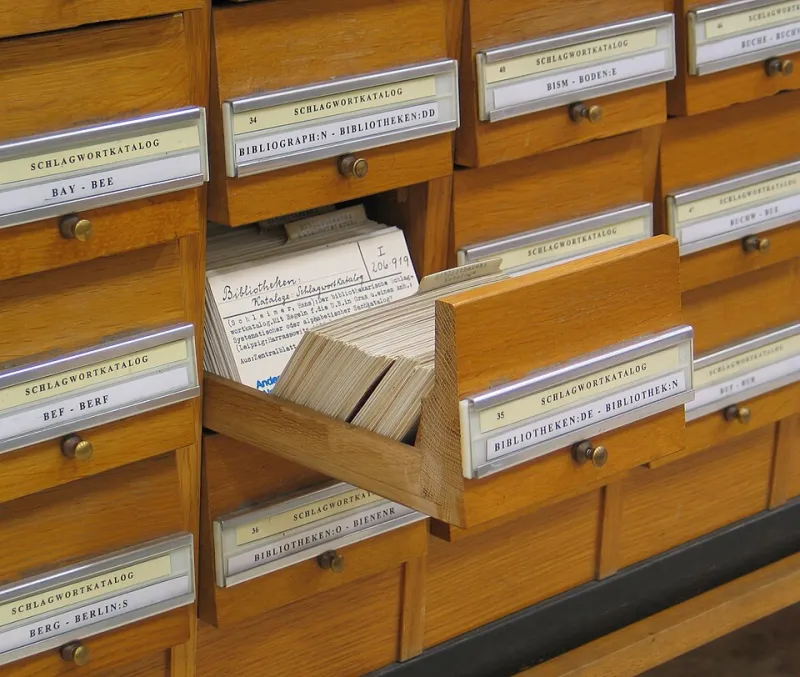
Photo: Dr. Marcus Gossler, CC BY-SA 3.0, via Wikimedia Commons
When a researcher types a term into a library catalog and presses enter, they are not simply querying a neutral database. They are navigating a system built on thousands of deliberate decisions made by catalogers—many of them decades ago—about what things are called, how concepts relate to one another, and whose vocabulary counts as authoritative. The Library of Congress Subject Headings, known universally in the profession as LCSH, represent one of the most consequential controlled vocabularies ever assembled. And like any human artifact, they carry the fingerprints of the era and the institution that produced them.
Origins: A Vocabulary Built for a Different America
LCSH traces its formal origins to 1898, when the Library of Congress began developing a list of subject headings to support its card catalog. The United States at that moment was a country in the midst of imperial expansion, racial segregation, and a cultural confidence that placed Western European intellectual traditions at the center of organized knowledge. These conditions were not incidental to how the vocabulary developed—they were structural.
Early subject headings reflected the worldview of their creators with remarkable candor. Terms that today would be immediately recognized as offensive or reductive were, for much of the twentieth century, the official language through which library users were expected to find materials about marginalized communities. The heading "Illegal aliens," for instance, persisted in the LCSH vocabulary until 2016, when it was replaced with "Noncitizens" and "Unauthorized immigration" following sustained advocacy from librarians, scholars, and community organizations. The change came only after years of formal proposals, public debate, and institutional resistance—a timeline that illustrates how slowly official vocabularies respond to shifting social norms.
The Sanford Berman Moment
No discussion of LCSH's cultural politics is complete without acknowledging the work of Sanford Berman, a cataloger whose 1971 book Prejudices and Antipathies served as a systematic indictment of bias within the vocabulary. Berman documented hundreds of headings he argued were demeaning, Eurocentric, or simply inaccurate, and his critique opened a sustained professional conversation about the relationship between cataloging language and social power.
Berman's intervention was not merely academic. He demonstrated, with painstaking specificity, that the choice of a subject heading is an act with real consequences: a community whose experiences are filed under a dismissive or othering term is, in a practical sense, rendered harder to find. The catalog becomes a barrier rather than a bridge. His work inspired subsequent generations of catalogers and researchers who have continued to interrogate LCSH on grounds of race, gender, sexuality, disability, and indigenous identity.
How Outdated Headings Persist—and Why
One of the most persistent questions in the profession concerns why problematic headings survive as long as they do. The answer involves both institutional inertia and the genuine technical complexity of large-scale vocabulary maintenance. LCSH currently comprises more than 340,000 authorized headings. Changing a single heading requires not only updating the authority file but also reviewing and potentially modifying every bibliographic record that uses that term across participating institutions—a number that can run into the hundreds of thousands.
This is not a trivial undertaking. Libraries operating with limited staff and constrained budgets must weigh the cost of retrospective catalog cleanup against other priorities. The result is that outdated headings can linger in local catalogs long after the Library of Congress has officially revised them, creating a patchwork of terminology that varies by institution and undermines consistent access.
Beyond logistics, there is also the question of professional culture. Cataloging has historically prized consistency and stability; frequent revisions to established headings can disrupt workflows and introduce errors. These values, while sensible in themselves, can inadvertently privilege the status quo and slow the pace of necessary reform.
The Vocabulary as Mirror
Examining specific headings reveals the extent to which LCSH functions as a cultural document as much as a technical tool. For many years, the heading "Indians of North America" was used to describe the Indigenous peoples of the continent—a term that conflates hundreds of distinct nations under a label rooted in a five-hundred-year-old geographical error. Advocacy efforts have led to the development of more specific headings for individual nations and to the broader use of "Indigenous peoples" in certain contexts, but the legacy heading structure remains deeply embedded in catalog records across the country.
Similarly, headings related to LGBTQ+ identities underwent significant revision during the 1970s and beyond, moving away from classifications that treated homosexuality as a pathology toward terminology that reflects contemporary understandings. The heading "Sexual minorities," introduced as a broader term, remains controversial among some advocates who argue it groups disparate identities in ways that erase meaningful distinctions.
These examples are not anomalies—they are characteristic. Every area of human experience that has been subject to significant social renegotiation has left its mark on the LCSH record.
What This Means for Researchers and Librarians Today
For working librarians, awareness of LCSH's historical contingency is a professional obligation, not merely an intellectual curiosity. When assisting patrons with catalog searches, a reference librarian who understands the vocabulary's limitations can suggest alternative search strategies, cross-reference related headings, and flag materials that may be misfiled under outdated terms. This kind of informed mediation is precisely the value that trained information professionals add to a system that cannot be taken at face value.
For researchers, particularly those working in fields such as ethnic studies, gender studies, postcolonial studies, or indigenous knowledge systems, LCSH's embedded assumptions can directly affect the completeness of a literature review. A scholar who searches only under the authorized heading may miss materials cataloged under earlier, now-deprecated terms—or may fail to locate resources that were never adequately described in the first place.
Several initiatives are working to address these gaps. The Cataloging Lab, a community of practice focused on bias in subject headings, and the work of the Program for Cooperative Cataloging's SACO funnel projects have both contributed to ongoing vocabulary reform. The Library of Congress itself has accelerated its review of headings identified as offensive or outdated, though critics argue the pace remains insufficient given the scale of the problem.
The Stakes of Classification
At its core, the debate over LCSH is a debate about epistemic authority: who gets to name things, whose naming conventions are treated as default, and what it costs communities when the official vocabulary does not reflect how they understand themselves. These are not abstract philosophical questions. They have direct implications for library access, research discovery, and the ways in which institutions either serve or fail the communities that depend on them.
LCSH will continue to evolve, as it has throughout its history. The profession's growing commitment to diversity, equity, and inclusion in cataloging practice suggests that the pace of reform may accelerate in coming years. But the headings already in use—and the millions of catalog records built around them—will carry the marks of earlier eras for a long time to come. For librarians and researchers alike, reading those marks critically is not optional. It is part of the work.