Strange Terms, Rich Finds: The Unexpected Research Value of LCSH's Most Peculiar Headings

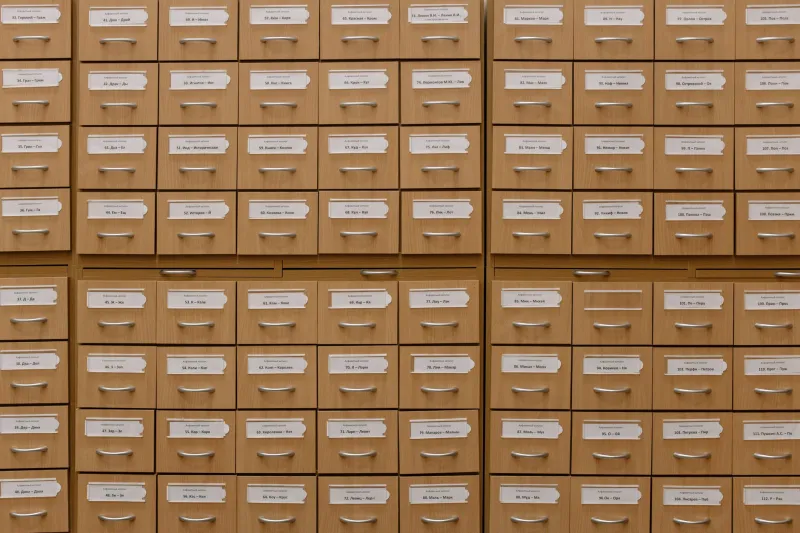
Photo: Unknown, Public domain, via Wikimedia Commons
The catalog, at its most functional, is a finding tool. But the catalog, at its most interesting, is something closer to an archaeological site—a layered record of the institutional assumptions, cultural anxieties, and classificatory enthusiasms of the people who built it. Nowhere is this more apparent than in LCSH's most eccentric headings: the oddly specific, the magnificently dated, and the terminologically peculiar. These headings are often discussed as problems to be solved. Occasionally, they deserve to be recognized as resources.
This is not an argument against vocabulary revision. Headings that cause harm, encode bias, or fail the communities they purport to describe must be corrected. But the history of LCSH also contains headings that are merely strange, highly specific, or rooted in intellectual frameworks that have since been superseded—and these, it turns out, can be extraordinarily useful to the researchers willing to engage with them on their own terms.
The Virtue of Excessive Specificity
LCSH's critics have long noted that the vocabulary can be excessively granular, generating headings so specific that they apply to almost nothing, or headings that subdivide topics in ways that no living researcher would think to search. But specificity, even absurd specificity, has a peculiar archival virtue: it preserves distinctions that broader vocabulary would collapse.
Consider headings that reflect historical categories of knowledge now largely abandoned. The heading "Phrenology," for instance, is no longer a respectable scientific category, but it remains a precise entry point into a substantial body of nineteenth-century literature that shaped American ideas about race, criminality, and intelligence. A researcher studying the intellectual history of scientific racism who searches under that heading is not endorsing phrenology; they are using the catalog's historical vocabulary to access historical materials that the catalog accurately, if uncomfortably, indexed under the terms their authors would have recognized.
The same logic applies to headings that reflect defunct administrative or legal categories. Headings related to historical property law, obsolete medical classifications, or superseded geographic and political entities can serve as precise navigational tools for legal historians, medical historians, and historical geographers whose work requires engagement with the past on its own terminological terms.
When Niche Becomes a Feature
Beyond the historically obsolete, LCSH contains headings of such narrow scope that they seem almost accidental—the product of a cataloger's particular enthusiasm or a momentary institutional decision to be very, very specific. These headings, too, can pay unexpected dividends.
Researchers who have spent time browsing LCSH's more obscure corners occasionally report a phenomenon that might be called productive bewilderment: the experience of encountering a heading so specific and unexpected that it opens an entirely unanticipated research direction. The heading becomes not a destination but a doorway, revealing that someone, at some point, thought a topic was important enough to warrant its own authorized term—and that behind that heading lies a collection of materials that might otherwise be invisible.
This dynamic is particularly valuable in interdisciplinary research, where scholars crossing disciplinary boundaries may not know the conventional vocabulary of adjacent fields. A sociologist studying agricultural labor who stumbles across a highly specific heading related to a regional farming practice may discover a body of extension service reports, agricultural experiment station bulletins, and local historical society publications that no standard database search would have surfaced. The oddity of the heading is, paradoxically, what makes it useful: it is specific enough to be discriminating, and it has been consistently applied across decades of cataloging practice.
The Serendipity That Controlled Vocabulary Can Still Produce
There is a long-standing critique of controlled vocabulary systems—including LCSH—that argues they suppress the kind of serendipitous discovery that open-stack browsing or free-text searching can produce. The argument holds that when researchers are constrained to authorized terms, they find only what the vocabulary anticipates, and miss what it cannot imagine.
This critique has genuine force, but it understates the degree to which LCSH's accumulated eccentricities can generate their own form of serendipity. Because the vocabulary was built incrementally over more than a century, by catalogers working in different institutional contexts and intellectual climates, it contains adjacencies and juxtapositions that no single designer would have planned. Browsing the authority file in the vicinity of a known heading can surface related headings that reflect conceptual connections no modern thesaurus would encode—because those connections were made by catalogers working in 1952, or 1937, or 1978, in response to the materials they were describing.
For historians of ideas, this layered quality is not a bug. It is a record of how institutions have understood the organization of knowledge over time, and that record is itself historically significant.
Case Studies in Accidental Utility
Several categories of LCSH heading have proven particularly productive as unexpected research resources.
Trade and occupational headings of the nineteenth and early twentieth centuries often encode distinctions that have since been flattened by broader economic categories. Headings related to specific craft trades, itinerant occupations, and now-defunct industries can lead researchers directly to trade publications, union records, and government labor surveys that document working-class life in granular detail unavailable through any other vocabulary.
Geographic headings for places that no longer exist as administrative entities—headings reflecting historical county boundaries, territorial designations, or municipal consolidations—function as precise search terms for local history collections organized around those now-obsolete jurisdictions. A researcher looking for materials about a community that was annexed into a larger city a century ago may find that the old LCSH heading for the original municipality is the most reliable path into relevant archival holdings.
Subject headings drawn from now-superseded scientific taxonomies can similarly serve as precise entry points into historical scientific literature. The history of science is, in significant part, a history of terminological change, and LCSH's retention of older scientific vocabulary—even when that vocabulary reflects superseded paradigms—preserves the ability to navigate that history with precision.
Reading the Catalog Against the Grain
What unites these examples is a common methodological principle: the catalog's strangeness can be read productively, not merely corrected. Researchers who approach LCSH's peculiar headings with curiosity rather than frustration often find that the very features that mark a heading as outdated or eccentric are also the features that make it useful.
This is not an argument for preserving harmful vocabulary or resisting necessary reform. It is an argument for recognizing that LCSH's accumulated history—including its mistakes, its enthusiasms, and its idiosyncrasies—constitutes a research resource in its own right. The catalog is not only a finding tool. It is also an archive of how American institutions have organized knowledge, and that archive, strange terms and all, repays careful attention.