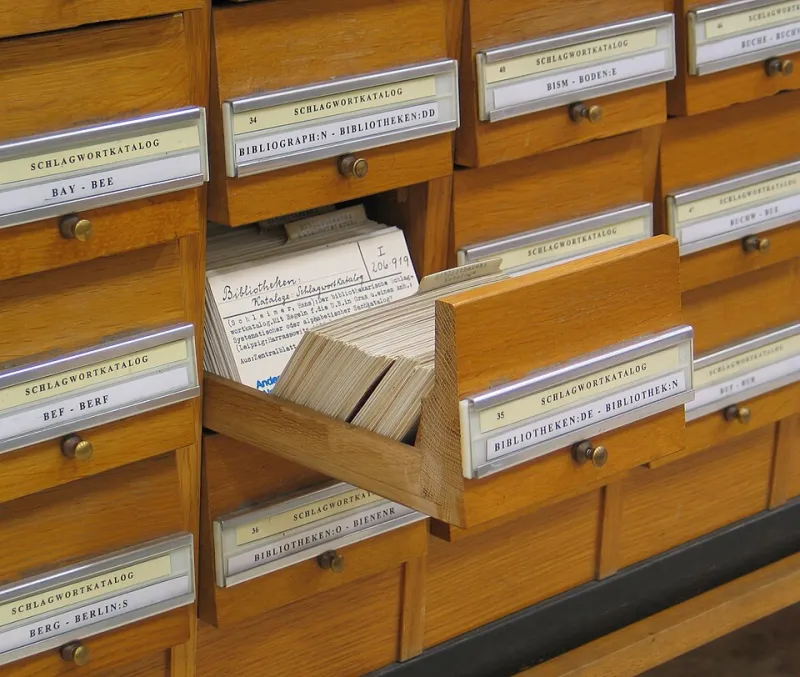
Cataloging Women Out of Existence: Gendered Bias in Library of Congress Subject Headings and the Work of Correcting the Record
Photo: Internet Archive Book Images, No restrictions, via Wikimedia Commons
A library catalog is never neutral. Every subject heading assigned to a resource reflects a decision—sometimes deliberate, sometimes unreflective—about how knowledge should be organized and who counts as a legitimate subject of inquiry. For women across history, scholarship, and the arts, those decisions have too often resulted in erasure, misclassification, or subordination within the Library of Congress Subject Headings (LCSH) system. Understanding how that happened, and what can be done about it, is essential work for any cataloger committed to meaningful access.
The Structural Problem: How LCSH Has Historically Framed Women
For much of the twentieth century, LCSH treated women primarily as a qualifying subdivision rather than as primary subjects in their own right. The heading construction "[Topic]—Women" or "Women—[Topic]" placed female subjects in an ancillary grammatical position, implying that the default subject of any given field was male and that women constituted a specialized subgroup requiring separate notation. Consider the contrast between a heading like "Poets" and the historically common construction "Women poets": the former carries no gender marker and thus implicitly signals universality, while the latter marks women as departures from an assumed norm.
This pattern was not accidental. It mirrored broader bibliographic conventions inherited from reference publishing, encyclopedia construction, and academic indexing practices that treated male experience as the baseline of human knowledge. The practical consequence was that resources by and about women were frequently siloed into gendered sub-categories, making them less visible in general subject searches and reinforcing the perception that women's contributions occupied a peripheral position in any given discipline.
Personal name authority records presented additional complications. Women who changed their names upon marriage were often cataloged under their married names even when their professional reputations had been built under birth names. The authority file for author Zora Neale Hurston, for example, required no such disambiguation, but countless lesser-known women scholars found their intellectual identities fractured across multiple authority records, complicating retrieval and obscuring the continuity of their careers.
Specific Heading Constructions Under Scrutiny
Several LCSH constructions have drawn sustained criticism from cataloging theorists and practitioners. The heading "Women as [profession]"—as in "Women as physicians" or "Women as scientists"—was particularly problematic. The prepositional construction implied that women's presence in a given field was conditional, aspirational, or anomalous rather than established. These headings have since been revised in many cases, with the Library of Congress shifting toward constructions such as "Women physicians" or "Women scientists" that treat professional identity as inherent rather than contingent.
The treatment of women in historical biography has also drawn scrutiny. Biographical subject headings for women have at various points emphasized domestic roles, marital relationships, or physical appearance in ways that have no parallel in headings applied to male historical figures. A nineteenth-century woman's catalog record might foreground her identity as a wife or mother while subordinating her intellectual or professional accomplishments, a framing that shapes how researchers encounter and interpret her legacy.
The heading "Feminism" itself illustrates the ideological complexity of subject heading construction. For decades, works addressing systemic gender inequality were channeled through headings that carried contested political valences, affecting how those resources were shelved, cross-referenced, and discovered. The boundaries drawn between "Feminism," "Women's rights," and "Sex discrimination" in LCSH reflect ongoing negotiations about how to represent a body of scholarship that challenges the very assumptions embedded in the cataloging system being used to describe it.
The Library of Congress's Remediation Efforts
The Library of Congress has not been indifferent to these critiques. Beginning in the 1970s, and accelerating through the 1990s and into the present century, LC has undertaken systematic reviews of gendered subject headings, responding to advocacy from the American Library Association, the Subject Analysis Committee, and individual cataloging professionals who documented specific instances of bias.
Those revisions have produced meaningful improvements. The "Women as [profession]" constructions have been largely retired. Heading structures that explicitly subordinated women's professional identities to domestic roles have been reconsidered. The authority file has been updated to reflect name usage preferences more accurately, with greater attention to how individuals identified themselves in their published work.
However, the pace of revision has been uneven, and the scope of the problem exceeds what periodic review cycles can fully address. LCSH contains hundreds of thousands of headings, and the resources required to audit them comprehensively for gendered assumptions are substantial. Many problematic headings remain in active use, either because they have not yet been flagged for review or because proposed revisions have not cleared the formal approval process.
Practical Challenges for Catalogers
For working catalogers, navigating the gap between current LCSH authority and the goal of equitable representation requires both technical knowledge and professional judgment. Several practical strategies deserve consideration.
Audit local authority records regularly. Many libraries maintain local authority files or apply local subject headings that supplement LCSH. These local additions offer an opportunity to bridge gaps in the national authority file, providing access points that reflect more current or more inclusive terminology without waiting for LC to act.
Leverage 653 fields for uncontrolled terms. The MARC 653 field allows catalogers to add uncontrolled index terms that do not correspond to established authority headings. When a resource addresses women's contributions in a field where LCSH headings remain inadequate, 653 entries can provide additional retrieval pathways for researchers using keyword searches.
Engage with the Subject Authority Cooperative Program (SACO). SACO allows cataloging professionals at participating institutions to propose new or revised LCSH headings directly to the Library of Congress. Documenting specific cases of inadequate representation and submitting formal proposals through SACO is one of the most direct ways individual catalogers can contribute to systemic change.
Consult supplementary vocabulary resources. Thesauri developed by specialized libraries and archives—including those focused on women's history, gender studies, and feminist scholarship—can inform local cataloging practice even when those terms are not part of LCSH. The Getty Art and Architecture Thesaurus and the Women's Thesaurus developed by the National Council for Research on Women offer useful reference points.
The Stakes of Getting This Right
Subject headings determine discoverability, and discoverability shapes scholarly conversation. When women's contributions are misclassified, subordinated, or simply absent from the controlled vocabulary of a major research catalog, the practical effect is to make those contributions harder to find, harder to cite, and harder to integrate into the ongoing construction of knowledge in any given field.
This is not a peripheral concern for academic libraries. It is a core question about whether the catalogs those libraries maintain are actually serving the full range of researchers who depend on them. Correcting the historical record embedded in LCSH requires sustained attention, institutional commitment, and the willingness of individual catalogers to treat subject heading assignment as an act with real intellectual and ethical consequences.
The catalog is never finished. Neither, therefore, is the work of making it more just.